
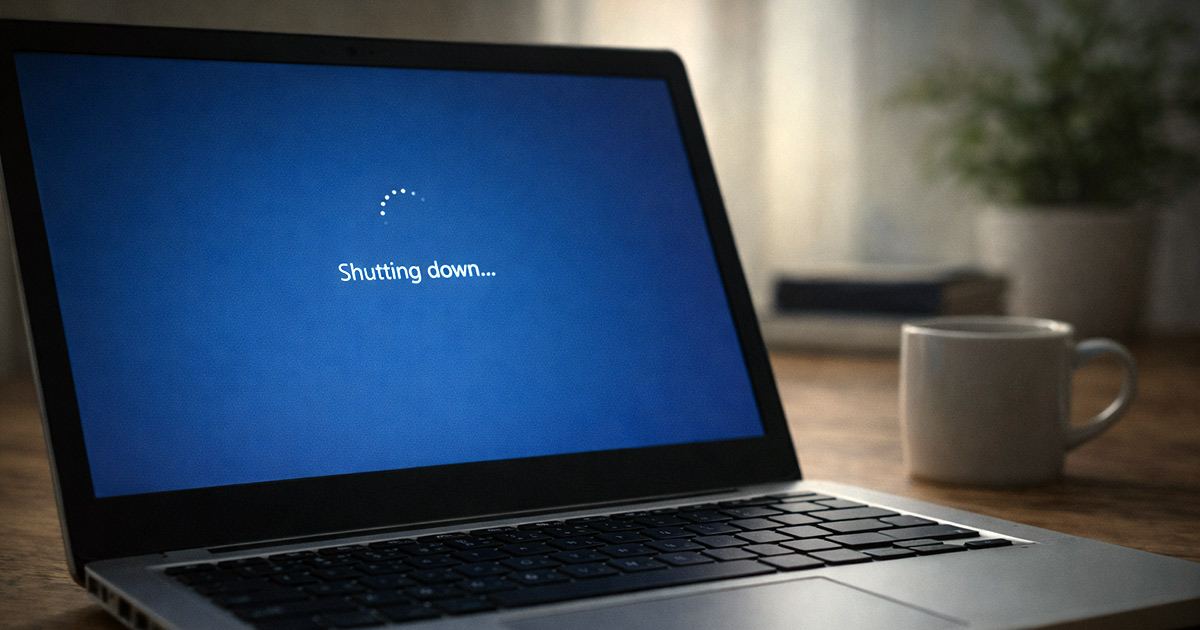
If your Windows laptop shuts down on its own — especially without warning — it’s almost never “random.”
Computers shut down automatically for specific reasons:
- Overheating
- Power problems
- Battery failure
- Driver or hardware errors
- System crashes
It might feel unpredictable. But there’s always a trigger.
Let’s walk through the most common ones.
First: Does It Shut Down or Restart?
This matters.
If it:
- Turns off instantly with no message → likely hardware or overheating
- Shows a blue screen first → likely driver or system error
- Restarts instead of shutting down → software crash
The pattern gives you direction.
The Most Common Reasons Windows Laptops Shut Down
1. Overheating (Most Common)
This is the biggest cause by far.
Laptops automatically shut down when temperatures get too high. It’s a protection feature — not a failure.
Signs this is the issue:
- Fan runs loudly before shutdown
- Bottom feels very hot
- It shuts down during gaming or heavy use
- It works again after cooling off
If the CPU overheats, Windows cuts power instantly to prevent damage.
Fix:
- Use the laptop on a hard surface
- Clean vents
- Check CPU usage in Task Manager
- Reduce background load
- Consider internal cleaning if it’s 2–3+ years old
Overheating is common. And usually manageable.
2. Failing Battery
If your laptop shuts down when unplugged — even with battery percentage remaining — the battery may be failing.
Common signs:
- Battery drops from 40% to 5% suddenly
- Laptop shuts off at random percentages
- It works fine while plugged in
Batteries degrade over time. Especially after 3–5 years.
Test:
Use the laptop plugged in only.
If shutdowns stop, the battery is likely the cause.
3. Power Adapter Issues
If your laptop shuts down while plugged in, the charger may be:
- Loose
- Damaged
- Underpowered
- Not delivering stable voltage
Even small power interruptions can cause shutdowns.
Check:
- Does the charging light flicker?
- Does moving the cable cause disconnects?
If yes, replace the adapter.
4. Driver or Windows Errors
Sometimes Windows crashes due to:
- Corrupt drivers
- GPU driver issues
- Windows update conflicts
- Hardware communication errors
In this case, you may see:
- A blue screen
- A brief error message
- Automatic restart
Check Event Viewer for critical errors if this is happening.
Fix:
- Update Windows
- Update graphics drivers
- Roll back recent updates if issue started afterward
Driver instability can absolutely cause shutdown behavior.
5. Failing Hardware (Less Common, But Real)
If shutdowns happen:
- Instantly
- With no warning
- At random times
- Even when idle
…there may be:
- Failing RAM
- Motherboard issues
- Power circuit problems
This is less common than overheating or battery issues — but it happens.
If everything else checks out, hardware may need inspection.
6. Fast Startup Glitch
Windows Fast Startup can occasionally cause instability.
If your system is not fully shutting down between sessions, it may create weird behavior.
Fix:
- Control Panel → Power Options
- Choose what the power buttons do
- Disable Fast Startup
It’s a simple test — and sometimes solves odd shutdown behavior.
Step-By-Step Troubleshooting (In Order)
Work through this calmly:
✔ Check if laptop is overheating
✔ Use it plugged in only (test battery)
✔ Try a different charger
✔ Update Windows and drivers
✔ Check Event Viewer for critical errors
✔ Disable Fast Startup
✔ Clean vents and improve airflow
You don’t need to assume motherboard failure right away.
Start with the common causes.
When It’s More Serious
You may need professional repair if:
- Shutdowns happen multiple times daily
- Laptop won’t power back on immediately
- You hear clicking or electrical sounds
- It shuts down even in BIOS
If it shuts down outside Windows (like in BIOS), that usually means hardware — not software.
Final Thoughts
If your Windows laptop shuts down randomly, it’s not acting randomly.
It’s protecting itself.
Most of the time, the cause is:
- Overheating
- Battery degradation
- Power instability
- Driver errors
Start with heat and power first. Those are the most common.
And no — random shutdowns don’t automatically mean your laptop is finished.
They usually mean something specific needs attention.
If you’re troubleshooting other Windows stability issues, explore the related guides on FixTechProblem.com for clear, step-by-step solutions.